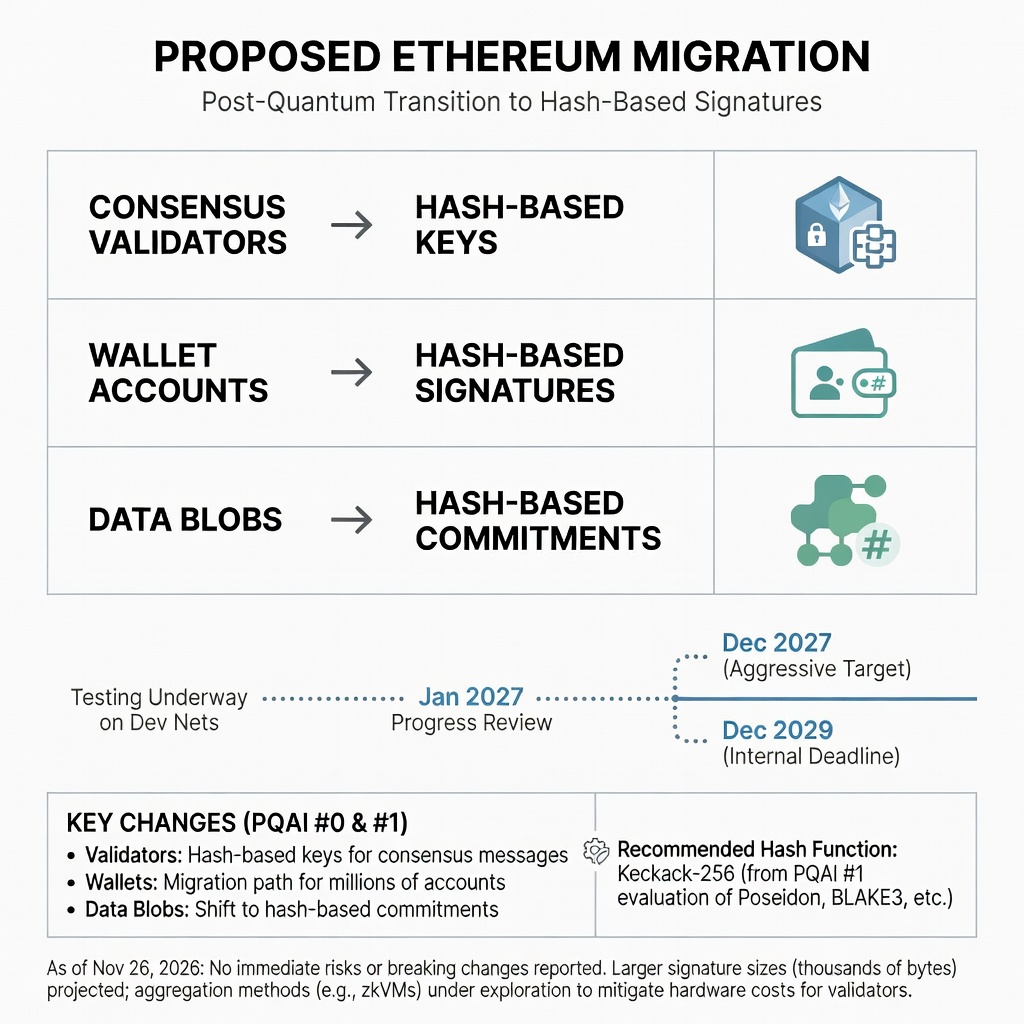
The Ethereum Foundation has made replacing elliptic-curve signatures with hash-based alternatives a protocol security priority. Its November 23–24, 2026 proposals cover validators, wallets and data blobs. Testing is underway on development networks, but Ethereum has not adopted a migration date: the Foundation’s internal deadline is December 2029, while other proposals target as early as December 2027.
The Foundation is preparing for a possible future threat, not responding to a reported exploit. Ethereum wallets use elliptic-curve cryptography to prove control of funds without revealing a private key. A sufficiently powerful quantum computer or an AI-assisted advance in cryptanalysis could eventually undermine that protection. Hash-based signatures rely on different mathematical assumptions.
What would change
In PQAI #0, published November 23, the Foundation outlined three changes:
- Validators would use hash-based keys to sign consensus messages.
- Wallet users would have a way to migrate existing accounts to hash-based signatures. Coordinating that switch across millions of accounts is a challenge distinct from designing the signatures themselves.
- Data blobs would move to hash-based commitments rather than signatures.
In PQAI #1 on November 24, the Foundation recommended Keccak-256 after evaluating alternatives including Poseidon and BLAKE3. Keccak-256 has a strong record of scrutiny by cryptanalysts and is already part of Ethereum’s infrastructure. The Foundation formed a dedicated Post-Quantum Security team in January 2026 and has also doubled the size of its protocol security team.
Signature size and the timetable
Developers project that hash-based signatures would be thousands of bytes larger than the signatures Ethereum currently uses. That extra data could raise node operators’ hardware costs, particularly for smaller validators. Developers are exploring aggregation methods, including approaches that use zero-knowledge virtual machines (zkVMs), to give the network something smaller to verify than many individual signatures.
As of November 26, 2026, there were no reported risks of immediate breaking changes or exploits. A progress review expected in January 2027 may clarify whether the earlier target is feasible; neither target is a confirmed activation date.