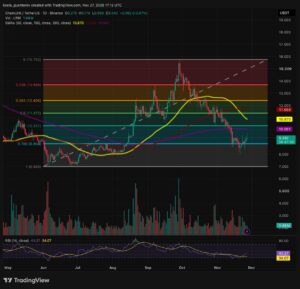
More than $600 million from the $6.3 billion Binance theft had moved through THORChain, Reuters reported on November 26, 2026. TRM Labs estimated that the cross-chain exchange protocol may have earned about $1 million in fees on those transfers. The FBI had already published wallet addresses it attributed to the North Korean attackers and urged crypto service providers, including THORChain’s node operators, to block the funds.
THORChain co-founder Chad Barraford defended the protocol’s policy of not censoring transactions. In a video response, he said 98% of THORChain transactions served users’ personal financial freedom and argued that shutting down the network would simply send the attackers elsewhere. The fee estimate gives THORChain’s policy a financial dimension, but it does not establish why the protocol declined to intervene.
What the on-chain figures show
On November 16, on-chain tracking put THORChain’s share of the laundering activity linked to the Binance theft at about 3%, with Chainflip and WabiSabi CoinJoin accounting for the main routes. By November 27, THORChain had again become a major route. The shift helps explain Barraford’s argument about alternatives, but it does not show how much the attackers ultimately cashed out.
Some $2.85 billion in stolen assets had been frozen. On November 23, the US Justice Department filed a civil forfeiture action in the US District Court for the District of Columbia seeking permanent forfeiture of about $1.2 billion in USDC already frozen on-chain. The filing was a request for forfeiture, not a court order granting it.
Separately, OnchainLens identified about $1.895 billion in unfrozen ETH and BTC still visible on-chain. That estimate and the $2.85 billion freeze figure cover different categories and observation times. Subtracting both from the original theft leaves about $1.555 billion, but that difference is not a measure of successful laundering. It may include assets transferred elsewhere, funds still moving through mixers or assets already converted to cash. Public data did not establish the split.
A network halt is not an address freeze
THORChain intervened in May 2026 after an attacker exploited a flaw in the GG20 threshold-signature mechanism and took about $10.7 million from an Asgard vault. An automated solvency check paused trading and signing on several chains. Node operators and community members coordinated a network-wide halt within about two hours, and the protocol remained offline for five weeks.
That episode showed that operators could stop the network. The dispute after the Binance theft was whether they should intervene against specific, publicly identified addresses. THORChain has long rejected transaction screening and identity checks, and in September it declined to help Bitget freeze stolen assets, citing decentralization.
Polygon took a different approach. In early November, Polymarket and Binance proposed a Polygon PoS hard fork that would remove about 70.49 million POL from attacker addresses and credit an equal amount to designated recovery addresses. A Polygon governance meeting agreed to the proposal, but as of November 27 it remained under internal discussion and technical planning. The balances had not been changed under the proposal.
Earlier thefts put the fee estimates in context
After the $1.5 billion Bybit theft in 2025, more than 85% of the unfrozen funds, about $1.2 billion, moved through THORChain. On-chain analysts estimated THORChain’s fee revenue at $10 million to $12 million over ten days. Stolen funds also passed through the protocol after the roughly $387 million Bitget theft in 2026. THORChain handled about $1.38 billion in total transaction volume over the relevant days, which accounted for most of that month’s revenue. That volume was not an estimate of stolen Bitget funds.
Those cases illustrate the distinction at the center of the Binance dispute: a protocol can collect fees on transfers without directly participating in the theft or laundering. The unresolved question is what responsibility its operators have once investigators identify the wallets involved.