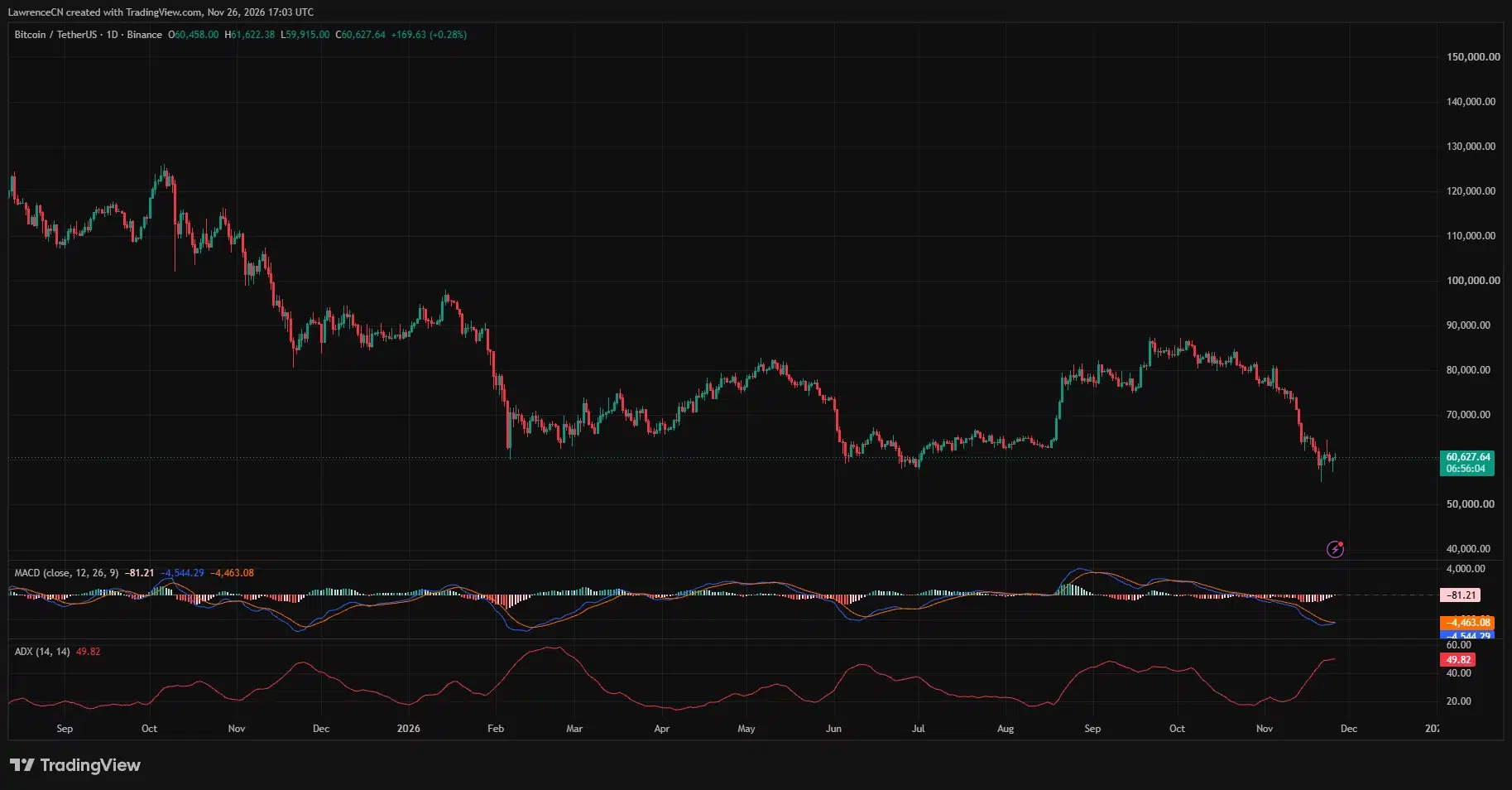
Bitcoin traded near $60,600 on Nov. 26, 2026, down about 3.8% over seven days, according to TradingView’s Binance BTC/USDT charts. The weekly figure masks a sharper swing: Bitcoin fell 12.4% from its Nov. 19 opening price of roughly $62,987 to a Nov. 21 low near $55,150. It rebounded above $64,000 on Nov. 23, then traded below $60,000 on both Nov. 24 and 25.
ETF withdrawals continued through the rebound
U.S. spot Bitcoin ETFs recorded $2.51 billion in net withdrawals across five consecutive trading sessions from Nov. 19 through Nov. 25, according to Farside Investors. Those sessions accounted for nearly 47% of November’s $5.39 billion in net outflows through Nov. 25. Net withdrawals had reached $2.89 billion by Nov. 18, with BlackRock’s iShares Bitcoin Trust accounting for roughly 83% of that amount.
Nov. 20 saw the largest net outflow of the five sessions: $669.2 million, including $544.7 million from BlackRock’s fund. Investors withdrew a net $569.7 million on Nov. 23 even as Bitcoin rallied. Net withdrawals eased to $231.4 million on Nov. 24 before rising to $453 million on Nov. 25, of which $329.7 million came from BlackRock’s fund.
Bitfinex Alpha put the Nov. 23 high at $64,673 on its exchange. Bitcoin’s rally coincided with a 6.5% gain in the Nasdaq Composite following Jensen Huang’s return as Nvidia CEO, according to Bitfinex. By the end of the session, Bitcoin was back at $61,300, a level the exchange had identified as resistance. Its midweek update also recorded a 13,200 BTC increase in futures open interest while Bitcoin’s price fell 2.4%. Bitfinex interpreted positive funding during the decline as a sign that leveraged traders were buying the dip.
On Nov. 25, the U.S. Bureau of Economic Analysis revised third-quarter GDP growth from 3.4% to an annualized 4.3%. A separate release put annual core personal consumption expenditures inflation at 3.3%, up from 3.1% in September. Overall PCE inflation was 3.8% year over year. Core prices, which exclude food and energy, rose 0.3% from September, matching the previous month’s pace.
Selling momentum eased, but the weekly trend remained negative
The Nov. 26 Binance daily chart showed Bitcoin at $60,628 after a session high of $61,622. The MACD histogram remained below zero but had narrowed, suggesting selling momentum had eased. That was not the same as a trend reversal: rallies were still stalling below prior highs, and the average directional index, a measure of trend strength rather than direction, stood at 49.82.
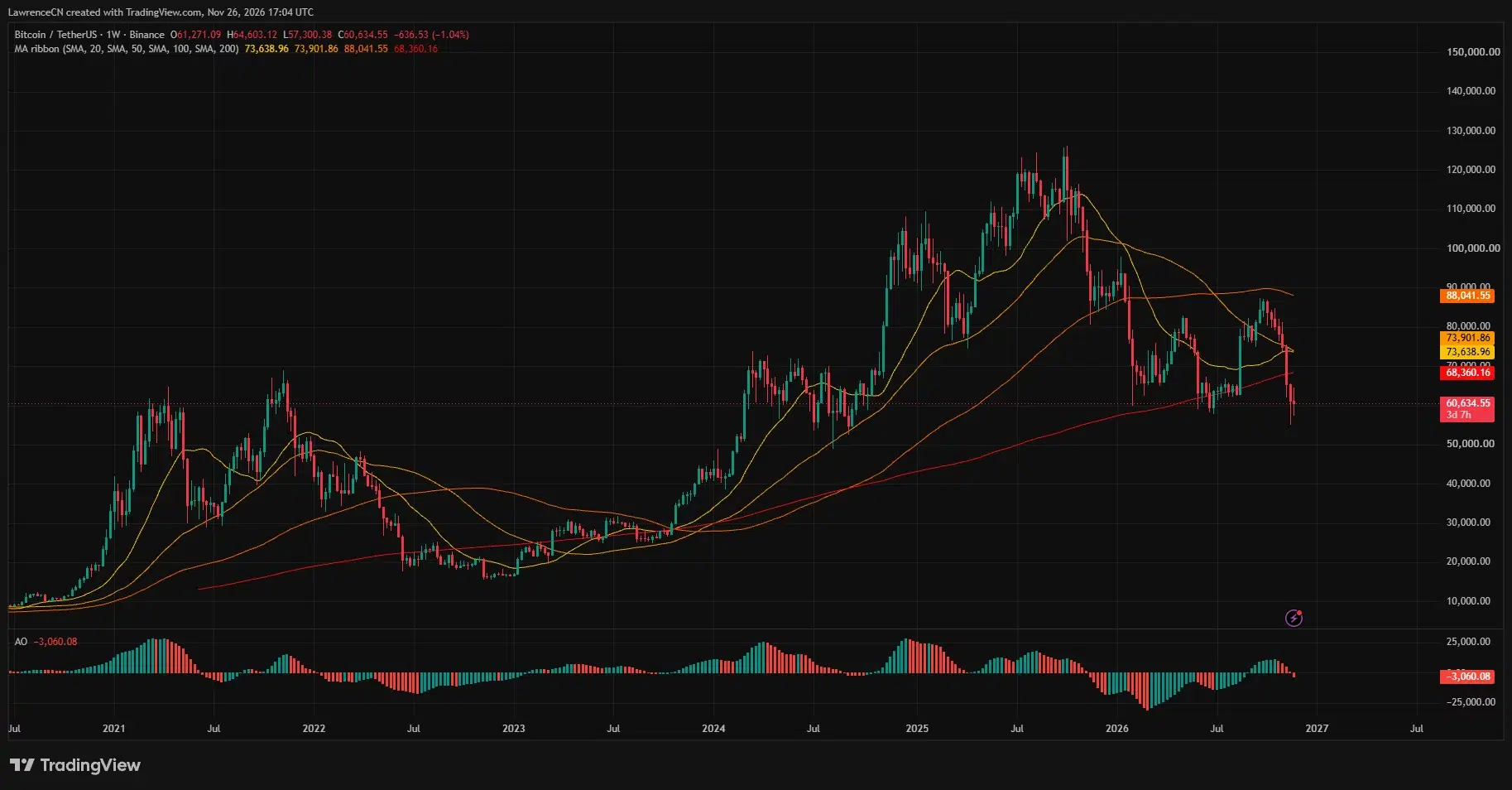
Bitcoin remained below all four moving averages on the weekly chart. The closest was the 200-week simple moving average at about $68,360, almost 13% above the latest chart price. The 20-week average was near $73,600, the 50-week near $73,900 and the 100-week near $88,040. The weekly Awesome Oscillator remained below zero. The still-open weekly candle showed a decline of about 1% from the Nov. 23 open, a shorter comparison than the 3.8% decline measured from Nov. 19.
Commentators offered different readings on Nov. 26. Crypto Patel identified $57,700 as support and said a break could open the way toward $40,000. Joep Gerla, citing CryptoQuant, said a combined 30-day measure of spot and perpetual futures demand growth had fallen to its lowest level since 2019. Gerla interpreted the depth of that decline as a sign a recovery might be closer; the reading itself did not establish a turning point.
Potential liquidations versus recorded closures
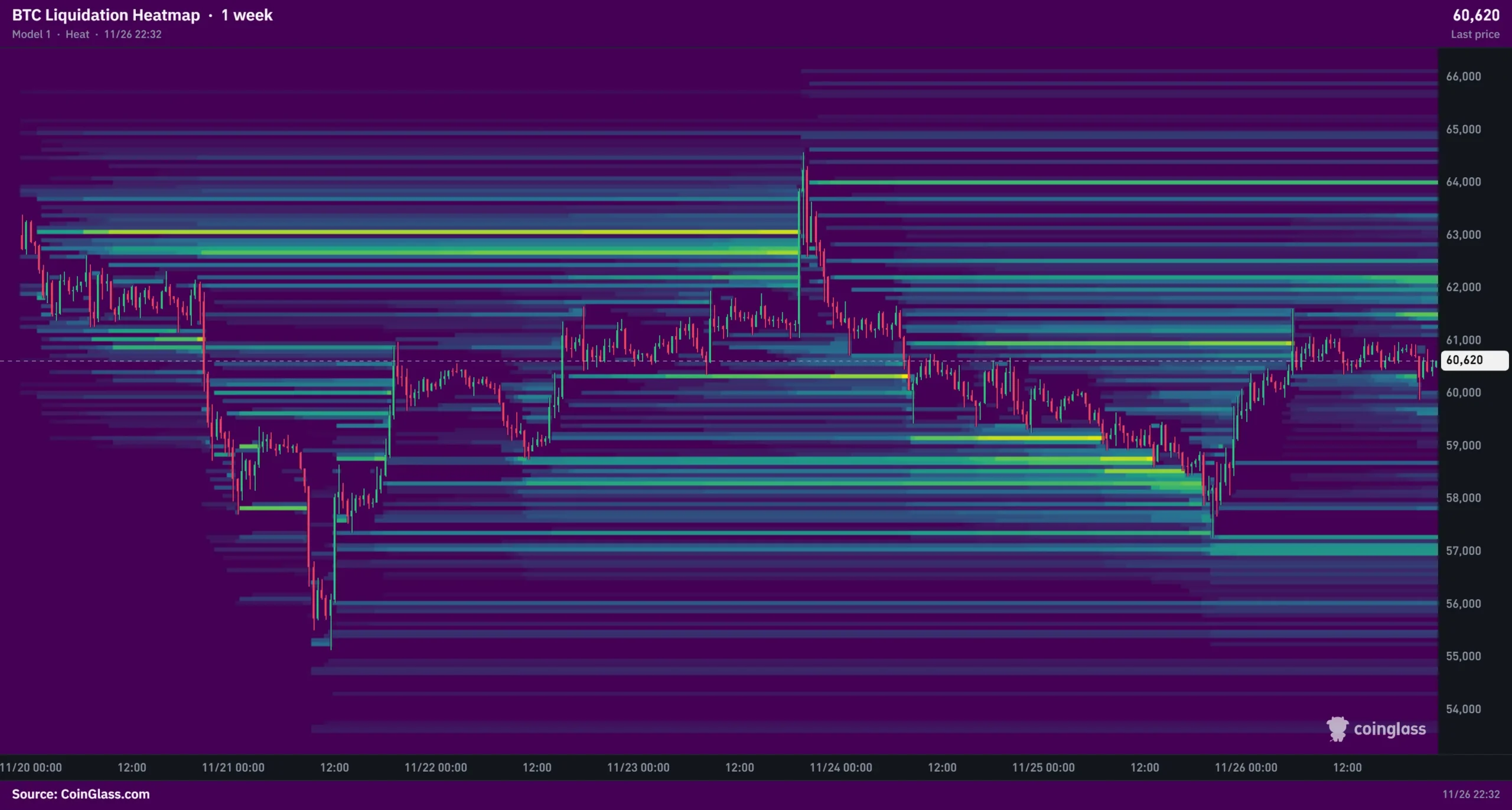
CoinGlass’s seven-day heatmap placed potential liquidation clusters above the Nov. 26 price at $61,500–$62,200 and near $64,000. Below the market, another cluster sat near $57,000, close to the Nov. 25 lows. These were estimates of where leveraged positions could be forced to close if Bitcoin reached those prices, not recorded liquidations or price targets.
Liqwall separately tracked $582 million in executed Bitcoin liquidations across the exchanges it covered on Nov. 21, including $362 million in long positions. On Nov. 25, when Bitcoin recovered from another dip below $60,000, Liqwall recorded $214 million in forced closures, including $89.9 million in shorts.